Domesday Travel
I love the Domesday Book. It's an amazing piece of history here in the UK, a complete register of (most of) the UK in 1086, nearly an entire millenia ago. Incredible.
I'd love to visit all of the locations mentioned in the book. Some of them have changed significantly, some of them less so, some of them don't even exist anymore!
Here's my Domesday Travel Book:
Current Map
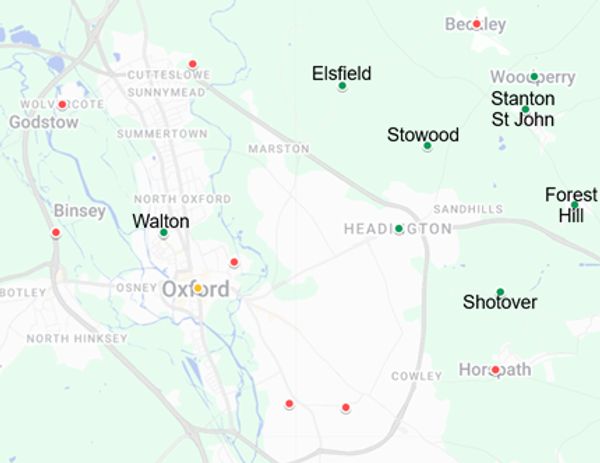
Done so far:
Needs work:
- Walton (This article is missing some details, especially around ancient sites, but is still largely usable)
Draft only:
- Oxford (Orange, I feel my initial write-up was poor and want to go back and do a much more extensive version)
Important Info
Terminology
- Domesday Book - In 1066, William the Conqueror, the Duke of Normandy, invaded and conquered England. From 1085 to 1086, the book was compiled so that William had a good idea of what was in England, who owned it, and how much it was worth. This is vital information he needed to know for tax purposes. Sources from the time describe the book as exceptionally thorough.
- Value - The Book records the value of each location. This is generally understood as the revenue produced by a given location in one year. Money is recorded in pounds, shilling, and pence. There's 20 shillings in a pound, and 12 pence in a shilling. Shillings only stopped being legal tender in 1990!
- Villagers, Smallholders, & Slaves - These are the three main groups recorded in the Domesday Book. Each location will list the amount of households, composed of villagers, who on average held 30 acres of land and two oxen for ploughland, smallholders, who held a much smaller amount of land (on average only 5 acres), and slaves. Some places may have none of these groups, but that's unusual. All three of these groups are considered "unfree", because they did not have the right to move without the consent of the lord of the local area.
- Hundred - The local government of the time. Hundreds were administered from a major town, although the meeting place of a Hundred tended to be a separate location, such as a major field. The court of a Hundred would meet at the meeting place once a month.
A Quick Bit About The History of England
To understand some of what I'm saying, it's essential to understand the basics of human history in England; below is a quick summary.
Before 4100 BC England, was inhabited by hunter-gatherers who built nothing. Starting in 4100 BC, early Neolithic farmers began to migrate over from the continent. These migrants settled in England and introduced farming and the first structures. Long Barrows and chambered tombs were built in the Neolithic era, as were many stone circles. Avebury and the West Kennet Long Barrow are both from the Neolithic era.
The Neolithic transitions into the Bronze Age starting 2400 BC when the Indo-Europeans migrate into England, nearly completely replacing the people living in England at the time. The Indo-Europeans introduce a concept of individual burials, aka round barrows, also called burial mounds or tumuli. For our purposes, these barrows will be our most common reference point to the Bronze Age, although there are some hillforts constructed in the late Bronze Age. Stone circles also stop being built about halfway through, although the most famous Bronze Age monument is a stone circle - Stonehenge.
It's unclear when the Celts first arrive in England. I think the theory that waves of migration from the general France region over several centuries in the buildup to the Iron Age makes the most sense, but theories range wildly. What's important is that it's clear that they were well established and were a majority of the population of England at the start of the British Iron Age in about 800 BC. The Celts in England adopt a clearly unique identity from those in the European mainland, and are usually referred to today as Britons, although they are deeply divided into various tribes, some of which have cultures that diverge wildly. The Celts largely abandon the use of barrows, and most of the structures from this period are hillforts. Other kinds of earthwork are known to exist, and permanent continuous settlements become increasingly common. Dorset's Maiden Castle is from the Iron Age.
In 43 AD the Romans begin to properly occupy England, invading as far north as north-east Scotland before withdrawing back to Hadrians Wall, in the modern-day far north of England. The Romans transform the culture of England, establishing complex archeology not seen before in the isles, and archaeology that lasts - Roman villas are found often, and other Roman walls and structures can often be visisted. The Romans also introduce Christianity into England, which quickly becomes the majority religion among the Celtic population. Famous Roman ruins include Hadrians Wall and the Roman Baths of Bath.
The Romans withdraw from Britain entirely in 410 AD, leading to what is known as Sub-Roman Britain or Dark Age Britain. The previously united England scatters into an array of different kingdoms. At first these kingdoms are mostly Celtic, with varying degrees of Roman influence, but quickly after the Romans leave, the Anglo-Saxons (tribes from modern-day north-west Germany, north-east Netherlands, and west Denmark) establish themselves in the east of England and begin to take over. Initially the Anglo-Saxons are restricted to the eastern half of England.
The Saxons slowly conquor all of England. The Saxons are initially entirely pagan, and as such reintroduce the use of barrows, but convert to Christianity in the 600s. Parts of England hold out and maintain rule by Celts, but the last Celtic kingdom in England, in Cornwall, falls in the early 800s, although Cornwall retains a much more distinctly Celtic identity compared to the rest of England. The Anglo-Saxons develop their own identity, and their own language - Old English. This language is the etymological root for most placenames in the Domesday Book.
In 865 the Vikings arrive, invading England as far south as Wiltshire, Hampshire, and London, before Alfred the Great beats them back. The Vikings establish the Danelaw in the north-east of England, including East Anglia, and once again reintroduce the open practice of paganism, before the last Viking ruler is driven out of England in 954. The Vikings return with a vegeance soon though, and England (apart from Cornwall and Cumbria, the latter having previously been Viking but now a part of a Celtic Brittonic Kingdom that included most of Scotland) becomes a part of the Viking North Sea Empire from about 1016 to 1042. The Vikings have a major affect on the placenames and language of the North-East of England, which continues to this day.
The Saxons become rulers of England again in 1042, just in time for the Norman conquest of 1066. The Normans thoroughly take over the ruling and ownership of land in England, but the language established by the Anglo-Saxons forms the basis of the modern English language, which every subsequent invader has been made to adopt, and the Anglo-Saxons are usually recognised as the start of the English as a people. Prior to this, the Christianity practiced in England was a blend of mainline Christianity with many customs descended either from the Celts, Saxons, Vikings, or a combination of some or all. The Normans, as part of their conquest, systematically eradicated the locally practiced variants of Christianity, enforcing mainline medieval Catholic Christianity on Britain. Most parish churches in England are Norman, but, as you will read, many were based in places where Saxon churches once stood, and some can be traced back to being grounds for religious practice much before that.
(It's worth mentioning that the Welsh language is entirely Celtic Brittonic. Irish, Manx and Scots Gaelic are all Gaelic languages, Gaelic are also Celtic, but not Brittonic.)
Oxfordshire (Oxenefordscire)
2026 - Kingsepron (James taylor)